Last updated June 18, 2026
Seasonal Roofing Care for Las Vegas: Year-Round Homeowner’s Guide
Most roofing guides are written for climates that don’t exist in Las Vegas. They walk you through gutter-clearing after fall leaves and ice dam prevention in January — neither of which applies here. What Las Vegas homeowners actually face is a two-threat climate: ultraviolet radiation intense enough to degrade roofing materials in a single season, and a monsoon window that arrives every July and punishes anything the summer heat has already weakened. If you’re maintaining your roof on a generic four-season schedule, you’re preparing for the wrong problems at the wrong times. This guide fixes that with a Las Vegas-specific calendar built around the two threats and the two maintenance windows that matter most.
Quick Answer
Las Vegas roofs don’t follow a traditional four-season maintenance pattern. The two highest-value actions a homeowner can take are a thorough inspection in March–May (before UV intensity peaks and before monsoon season begins) and a damage-assessment inspection in October–November (after monsoon season closes). Everything else in the year supports those two windows. Skipping either one is how small, inexpensive repairs turn into full replacements.
Table of Contents
- Understanding Las Vegas’s Two-Threat Roofing Climate
- Spring Maintenance Window (March–May): The Highest-Value Work of the Year
- Summer Survival (June–Early July): What Extreme Heat Does to Your Roof
- Monsoon Season (July–September): What It Does and What It Reveals
- The Attic Heat Problem: 160°F and Shingle Degradation From Below
- Fall Recovery Window (October–November): The Inspection That Prevents Replacements
- Winter Maintenance (December–February): Low-Risk, Not No-Risk
- Month-by-Month Las Vegas Roofing Calendar
- Common Mistakes to Avoid
- When to Call a Professional
- Frequently Asked Questions
- The Bottom Line
Understanding Las Vegas’s Two-Threat Roofing Climate
Las Vegas doesn’t punish roofs the way Chicago or Atlanta does. There’s no freeze-thaw cycle cracking your flashing, no ice damming behind backed-up gutters, no sustained autumn rain soaking into wood decking. What Las Vegas does instead is concentrate its damage into two distinct threats that operate on opposite ends of the calendar and opposite ends of the moisture scale.
Threat One: UV and extreme heat. Las Vegas averages over 300 days of sunshine per year, with summer surface temperatures on a dark asphalt shingle roof regularly exceeding 170°F. Roofing materials are engineered with temperature ratings, but sustained exposure at those extremes accelerates oxidation in asphalt, drives volatile oils out of shingles until they become rigid and granule-shedding, and bakes sealant strips into a brittle crust. A shingle that looks fine from the ground in May can be functionally compromised by August.
Threat Two: Monsoon moisture. Every July, the atmospheric moisture pattern shifts and Las Vegas enters its monsoon window — a period of high-intensity, short-duration rainfall events that run through September. These aren’t slow, soaking rains. They’re sudden storms that can drop a half-inch of rain in under 30 minutes, driving water into every gap, crack, and lifted edge that the summer heat created.
The interaction between these two threats is the thing most homeowners don’t account for. The heat creates the vulnerabilities. The monsoon finds them. A well-maintained roof survives both. An ignored roof fails at the seam between the two.
Spring Maintenance Window (March–May): The Highest-Value Work of the Year
If you’re only going to do one round of roof maintenance per year in Las Vegas, make it this one. March through May gives you the last period of mild, workable temperatures before the UV index climbs into its most damaging range — and it puts you four to eight weeks ahead of monsoon season, which is exactly the lead time you need to complete repairs before the rains arrive.
Here’s what to prioritize in the spring maintenance window:
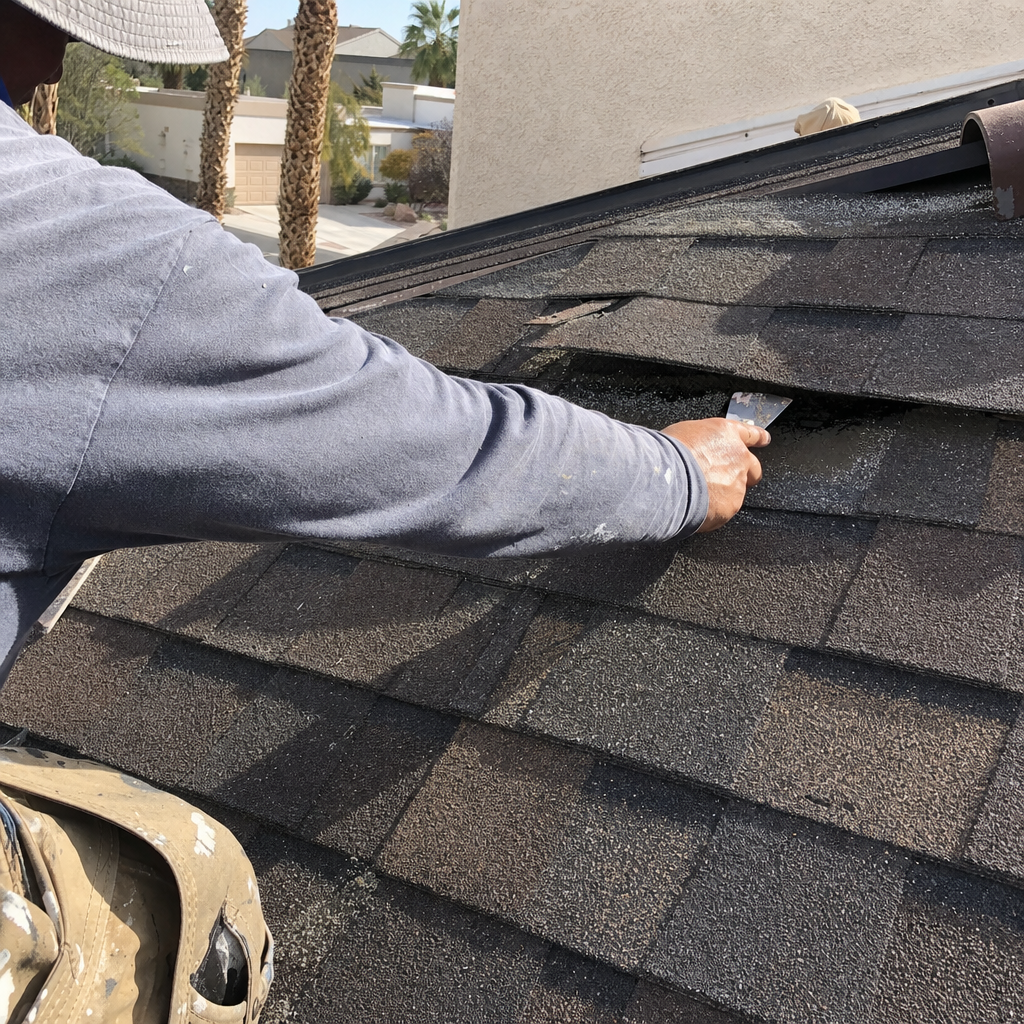
- Full shingle inspection. Look for granule loss, cracking along shingle edges, curling tabs, and any areas where shingles have lifted along their adhesive strip. After a year of UV exposure, granule loss is the most common finding in Las Vegas. Bare spots on asphalt shingles accelerate UV penetration to the substrate below.
- Flashing audit. Inspect every transition point — pipe boots, skylights, valleys, and where your roof meets any vertical wall surface. Flashing sealants contract and expand with temperature cycling, and Las Vegas temperature swings are severe. Re-sealing compromised flashing in April costs a fraction of what a monsoon-season leak repair costs in August.
- Gutter and drainage check. Clear any debris accumulated over winter and verify that downspouts are directing water at least four feet from the foundation. Las Vegas soil doesn’t absorb sudden water influxes well, and poor drainage during a monsoon storm can lead to foundation-adjacent pooling.
- Attic ventilation check. Open and inspect any ridge vents or soffit vents. Blocked ventilation directly raises attic temperatures in summer, which accelerates shingle degradation from below. More on this in the attic heat section below.
- Flat or low-slope roof membrane inspection. Many Las Vegas homes include flat sections — particularly over garages, covered patios, or additions. Check for blistering, seam separation, and standing water stains. Flat roof membranes are the first to show heat degradation and the most immediately vulnerable during monsoon rains.
Santos Cruz and the team at All Star Roofing Company Las Vegas home recommend scheduling spring inspections no later than the first week of May. Once June heat arrives, repairs become harder to schedule and the materials themselves are working against you.
Summer Survival (June–Early July): What Extreme Heat Does to Your Roof
By June, the maintenance window has closed and Las Vegas enters its most punishing stretch. Average high temperatures run between 104°F and 115°F from mid-June through mid-July, and roof surface temperatures run 50 to 70 degrees above ambient air temperature. That means a 110°F afternoon in Summerlin or Henderson translates to a roof surface pushing 175°F.
What’s happening to your roofing materials during this period:
- Asphalt oxidation. The asphalt binders in standard shingles release volatile oils at sustained high temperatures. Over time, this leaves the shingle brittle, prone to cracking, and unable to flex during the thermal contraction that comes with nighttime cooling.
- Sealant failure. The adhesive strips that bond shingle tabs become pliable, then brittle, through repeated heat cycles. When they fail, tabs lift — and a lifted tab in monsoon season is an open door for water.
- Granule migration. Heat loosens the bond between protective granules and the asphalt substrate. You’ll often find significant granule accumulation in gutters after the first major summer heat wave.
June is not the time for major repairs — it’s the time to monitor. If you completed your spring inspection, your roof should be in its best possible position entering summer. If you spot active leaks or significant damage during this window, don’t wait. Summer leaks in Las Vegas get worse quickly. Emergency response is part of what All Star Roofing handles, not an afterthought — call if something’s failing regardless of the season.
Monsoon Season (July–September): What It Does and What It Reveals
Las Vegas averages about 4.2 inches of annual rainfall, and a significant portion of that falls in concentrated bursts between July and September. The monsoon isn’t primarily a damage-creator — it’s a revealer. The structural damage was done by UV and heat. The monsoon is what makes it visible through your ceiling.
What the monsoon actually does to roofs:
- Exploits lifted flashing. Any flashing that separated during summer heat expansion becomes a water entry point the moment heavy rain drives sideways against it.
- Tests every sealant joint. Sealant that was merely cracked in June becomes a leak source under the hydraulic pressure of a 30-minute, high-intensity storm.
- Overwhelms debris-blocked drainage. Flat roof drains and low-slope scuppers that are partially blocked don’t matter much in a dry year. In a monsoon storm, a blocked drain means standing water, and standing water on a compromised membrane means interior damage.
- Reveals valley failures. Metal valleys concentrate roof runoff into a single channel. If the valley flashing has lifted or the sealant has cracked, that concentrated flow will find its way in.
During monsoon season, do a visual attic check after any significant storm. Look for water stains on the decking or insulation, soft spots in your drywall near exterior walls, and any daylight visible through the roof deck. If you find evidence of active intrusion, get a professional assessment before the next storm hits. In neighborhoods like Centennial Hills, North Las Vegas, and the southwest valley, we regularly see monsoon intrusions that trace back to flashing separations that could have been caught in a spring inspection.
The Attic Heat Problem: 160°F and Shingle Degradation From Below
Most homeowners think about roof damage from the outside in. The attic heat problem works in the opposite direction, and it’s one of the least-discussed contributors to premature shingle failure in Las Vegas.
In a poorly ventilated Las Vegas attic during July, air temperatures can reach 160°F to 180°F. At those temperatures, heat radiates upward into the roof deck and into the underside of shingles that are simultaneously being baked from above by 175°F surface temperatures. The shingle is being cooked from both sides.
The practical consequence: a properly ventilated attic can extend shingle lifespan by five to seven years compared to an under-ventilated attic in the same Las Vegas climate. Manufacturer warranties on products like GAF Timberline, Owens Corning Duration, or CertainTeed Landmark include ventilation requirements that, if unmet, can void coverage — a fact that matters when a Las Vegas homeowner tries to make a claim after premature failure.
How to assess your attic ventilation in Las Vegas:
- Check that soffit vents are not blocked by insulation, which is extremely common in older homes in areas like the central valley and North Las Vegas.
- Confirm your ridge vent runs the full length of the ridge, or that you have sufficient powered ventilation to compensate.
- On a hot afternoon, enter the attic with a thermometer. If you’re reading above 150°F, ventilation is inadequate for Las Vegas conditions.
- Look for discoloration or warping on the underside of your roof deck — both are indicators of chronic heat stress.
When Santos works a roof replacement in Las Vegas, ventilation assessment is part of the job — not a separate line item. Material decisions for brands like Atlas, Tamko, IKO, and Boral are made with the specific thermal load of your roof in mind.
Fall Recovery Window (October–November): The Inspection That Prevents Replacements
By October, monsoon season has wound down and Las Vegas temperatures drop into a workable range for roofing work. This is the second critical maintenance window of the year, and its purpose is different from the spring inspection. Spring is about preparation. Fall is about damage accounting.
After three months of monsoon exposure on top of a summer of UV stress, your roof has a story to tell. The fall inspection reads that story and separates the manageable repairs from the conditions that, if left through another summer, become replacements.
Fall inspection priorities:
- Granule loss assessment. Check your gutters for granule accumulation. A small amount is normal. Heavy granule deposits after summer indicate that shingles are losing structural integrity and likely have two to four years of remaining useful life, not ten.
- Flashing re-seal. Any flashing that survived monsoon season should be evaluated for re-sealing before it faces another summer heat cycle. Re-sealing in October costs under a few hundred dollars. Replacing a damaged deck section after a second monsoon season costs multiples of that.
- Valley and low-point inspection. After a monsoon season, valleys accumulate debris and show any wear patterns that developed under sustained water flow. Clear them and assess the metal for corrosion or lifting.
- Flat roof sections. Check for any membrane separation, blistering, or ponding evidence. Las Vegas flat roofs get their harshest test during monsoon season, and the fall window is when deferred maintenance becomes visually apparent.
- Fascia and soffit condition. Any water that got past the roof surface during monsoon season often shows up first as discoloration or soft spots in fascia and soffit material. This is also where pest entry points develop as temperatures cool.
For homeowners in North Las Vegas specifically, fall is also the window to address any repairs before winter permits and contractor schedules tighten. Roof Repair in North Las Vegas is available year-round, but October scheduling gives you the most flexibility.
Winter Maintenance (December–February): Low-Risk, Not No-Risk
Las Vegas winters are mild by national standards, but that doesn’t mean your roof is on vacation. December through February in Las Vegas averages between 8 and 12 overnight freeze events per year, and the combination of freezing nights and 60°F afternoons creates a daily thermal cycling stress on sealants and flashing that accumulates over the season.
What to monitor in winter:
- Thermal cycling at flashing points. Metal flashing expands and contracts with each temperature swing. In a Las Vegas winter with 40-degree daily temperature ranges, flashing seals that were marginally intact in November can separate by February.
- Debris after wind events. January and February bring Santa Ana-adjacent wind events across the Las Vegas valley. Inspect after any wind advisory for lifted shingles, displaced flashing caps, and debris that may have lodged against raised roof penetrations.
- Interior warning signs. Water staining on ceilings or walls that appears in winter often traces to flashing failures that developed over summer and monsoon season but weren’t caught in fall. Don’t wait until spring to investigate.
Winter is also the right time to plan and price any major work you want completed before the spring deadline. If a fall inspection revealed shingle degradation significant enough to warrant a full replacement, getting that scoped and scheduled in January or February puts you ahead of the spring rush and guarantees the work is done before UV season begins again. For full system replacements, our team handles the full process from material selection across all seven manufacturer lines through final inspection. Roof Replacement & Installation in North Las Vegas is available for consultation now.
Month-by-Month Las Vegas Roofing Calendar
Here’s how the maintenance year actually looks for a Las Vegas homeowner operating on the correct schedule — not a generic template adapted from a national roofing guide:
- January: Schedule any major work identified in fall inspection. Monitor for thermal cycling damage at flashing points. Review interior ceilings for any new staining after winter rains.
- February: Finalize spring inspection appointment if you haven’t already. Check for debris accumulation after wind events. Confirm attic ventilation is clear heading into warming temperatures.
- March: Spring inspection window opens. Begin full shingle, flashing, valley, gutter, and ventilation assessment. Priority: identify any issues that need repair before May.
- April: Complete all identified repairs. Re-seal any compromised flashing. Address attic ventilation deficiencies. This is the most repair-friendly month of the year in Las Vegas — mild temperatures, low UV, pre-monsoon.
- May: Final pre-summer check. Confirm all spring repairs are complete. Check flat roof sections one last time before heat arrives. Deadline: first week of May for any significant work.
- June: Heat season begins. Visual monitoring only. Note any shingle changes or granule loss for fall documentation. Do not schedule major repairs unless emergency conditions require it.
- July: Monsoon season begins. Inspect attic after major storm events. Watch for interior water signs. Emergency response is available if active leaks develop.
- August: Continue storm monitoring. Photograph any visible damage from ground level for documentation. Do not walk the roof in August heat — surface temperatures are dangerous and materials are most vulnerable to foot traffic stress in peak heat.
- September: Monsoon season closes. Begin preliminary damage documentation before fall inspection. Clear gutters and downspouts of monsoon debris accumulation.
- October: Fall inspection window opens. Full damage-assessment inspection. Prioritize flashing re-seal, granule loss evaluation, flat roof sections, and valley clearing.
- November: Complete all fall repairs identified in October inspection. Address any fascia or soffit issues before winter. Confirm drainage is clear heading into winter rain season.
- December: Low-activity month. Monitor interior for signs of any late-developing intrusions. Begin planning for following year’s major work if replacement is approaching.
Common Mistakes to Avoid
- Using a national four-season maintenance schedule. Generic roofing calendars that call for “fall gutter cleaning” and “spring inspection” without accounting for the July–September monsoon window will have you working backwards from the threats that actually matter in Las Vegas. Build your schedule around the two local threats, not the national template.
- Skipping the spring inspection because the roof looks fine. A Las Vegas roof that passes a visual scan from the driveway in March can have compromised flashing sealants and brittle adhesive strips that won’t survive a July monsoon. Surface appearance is not a proxy for structural readiness. Many of the worst leaks we see after monsoon season had no visible warning signs from ground level.
- Walking the roof in peak summer. Roof surface temperatures above 150°F make standard asphalt shingles soft enough to dent or crack under foot traffic. Inspect from the ground or a ladder at the eave in summer. Scheduled work requiring full roof access should happen in spring or fall.
- Ignoring attic ventilation because the shingles look intact. In Las Vegas, attic heat degradation from below is responsible for premature shingle failure that looks identical to age-related wear. If you replaced a roof that was only 12 years old, poor ventilation is likely part of the explanation. Manufacturer warranties on products like Owens Corning, CertainTeed, and GAF include ventilation requirements — inadequate ventilation can void those warranties entirely.
- Treating flat roof sections as a separate, lower-priority maintenance item. Many Las Vegas homes have flat sections over additions, covered entries, or attached garages. These sections are the highest-risk area on your roof during monsoon season, and they need the same inspection cadence as your sloped sections — not a “we’ll get to it” mentality.
- Waiting until after the monsoon to address a spring-detected problem. A flashing separation identified in April is a $200–$400 repair. That same flashing separation, after two or three monsoon storms have driven water through it and into the decking below, is a repair with water-damaged decking and potential interior work added to the bill. The spring window exists to prevent exactly this scenario.
- Choosing a contractor based on the lowest bid after storm damage. Post-monsoon Las Vegas sees an influx of out-of-area contractors offering emergency repairs. Hiring a crew with no local track record means no accountability if the repair fails by the following summer. Santos Cruz has 22 years of Las Vegas roofing reputation on the line with every job — that’s not a marketing line, it’s a practical accountability structure.
When to Call a Professional
Some roofing tasks — clearing gutters, checking attic ventilation, doing a visual inspection from the ground — are reasonable homeowner actions. But several conditions require a professional assessment immediately:
- Any active interior water intrusion, even if it appears minor. A small ceiling stain often represents a larger moisture path that isn’t visible.
- Visible shingle cracking, buckling, or large-scale granule loss observed from ground level.
- Flashing that is visibly lifted, separated, or corroded at any transition point.
- Any flat or low-slope membrane showing visible blistering, separation at seams, or standing water stains.
- Post-storm damage — lifted sections, displaced materials, or debris impact damage — even if the interior looks dry immediately after the event.
- A roof over 15 years old that has not had a documented inspection within the past two years, particularly before entering monsoon season.
For specialty systems like tile, modified bitumen, or TPO membrane roofing, professional inspection is the only reliable assessment method — these systems have failure modes that don’t announce themselves visually until significant damage has already occurred. Specialty Roofing in North Las Vegas covers the full range of those systems. All Star Roofing Company Las Vegas offers free estimates — call (725) 237-7255 to schedule yours.
Frequently Asked Questions
How often should I have my roof inspected in Las Vegas?
Twice per year is the correct cadence for Las Vegas — once in spring (March–May, before UV intensity peaks) and once in fall (October–November, after monsoon season closes). The Las Vegas climate creates two distinct damage windows that a single annual inspection will inevitably miss. Homeowners with roofs older than 15 years or with flat sections should prioritize both windows without exception.
What does monsoon season actually do to Las Vegas roofs?
The Las Vegas monsoon (July–September) primarily reveals damage that the summer heat already created — it doesn’t cause most of the structural failures itself. Heat bakes sealants brittle and lifts shingle adhesive strips; monsoon rain then drives water through those compromised points. A roof that was properly prepared in spring will typically handle monsoon storms without incident. A roof that entered July with deferred maintenance will often show interior leaks within the first few storms.
What’s the best roofing material for Las Vegas’s climate?
There’s no single right answer — it depends on your roof pitch, attic ventilation setup, budget, and how the home was originally built. In our experience, products engineered for high UV exposure and thermal cycling perform measurably better in Las Vegas than standard three-tab shingles. Architectural shingles from lines like GAF Timberline, Owens Corning Duration, and CertainTeed Landmark are commonly specified for Las Vegas residential work, but tile and flat-roof membrane systems are appropriate for many home configurations. The right choice is made by evaluating your specific roof, not by picking a popular brand name.
How do I know if my attic ventilation is adequate for Las Vegas summers?
The clearest test is a thermometer reading in the attic on a hot afternoon. If you’re reading above 150°F, your ventilation is insufficient for Las Vegas conditions. Other indicators include shingles that are aging faster than their rated lifespan, granule loss appearing on a relatively young roof, and insulation that shows discoloration or compression from sustained heat exposure. Blocked soffit vents — common in older Las Vegas homes — are the most frequent cause of ventilation failure and the easiest fix.
Can I do my own roof inspection in Las Vegas?
Ground-level visual inspections are a reasonable homeowner activity and should be done after every significant monsoon storm. You can identify obvious shingle damage, debris accumulation, and gutter issues from a ladder at the eave. What you can’t reliably assess from the ground: flashing integrity, flat roof membrane condition, early-stage granule loss, deck soft spots, and any damage on the back slopes of the roof. For anything beyond the ground-level visual, a professional inspection is worth the time — especially before and after monsoon season in Las Vegas.
How much does a roof inspection cost in Las Vegas?
Inspection pricing varies by company and scope. All Star Roofing Company Las Vegas provides free estimates, which includes a professional assessment of your roof’s condition and a clear explanation of any issues found. Call (725) 237-7255 to schedule. What a professional inspection actually costs you in the long run is often the difference between a $300 spring repair and a multi-thousand-dollar post-monsoon emergency — the inspection itself is the least expensive part of the equation.
The Bottom Line
Las Vegas roofs operate on a climate calendar that most national roofing advice ignores. The heat degrades, the monsoon reveals, and the two maintenance windows — spring and fall — are where the real work happens. Get your spring inspection done before May, complete any identified repairs before the monsoon arrives, and do a damage-accounting fall inspection in October before small issues carry over into another brutal summer. Attic ventilation isn’t a bonus item — it’s part of what determines whether your roof lasts 15 years or 25. Nearly 120 homeowners have given Santos and the All Star Roofing team a 4.9-star rating across 118 reviews, and that track record was built one well-maintained Las Vegas roof at a time.
Ready to get your roof assessed before the next season hits? Call All Star Roofing Company Las Vegas at (725) 237-7255 for a free estimate. Santos handles the inspection himself — you’ll get 22 years of Las Vegas roofing pattern recognition applied directly to your home, not a clipboard checklist from a crew you’ve never met.
Written by Santos Cruz, Owner & Lead Technician at All Star Roofing Company Las Vegas, serving Las Vegas since 2004.