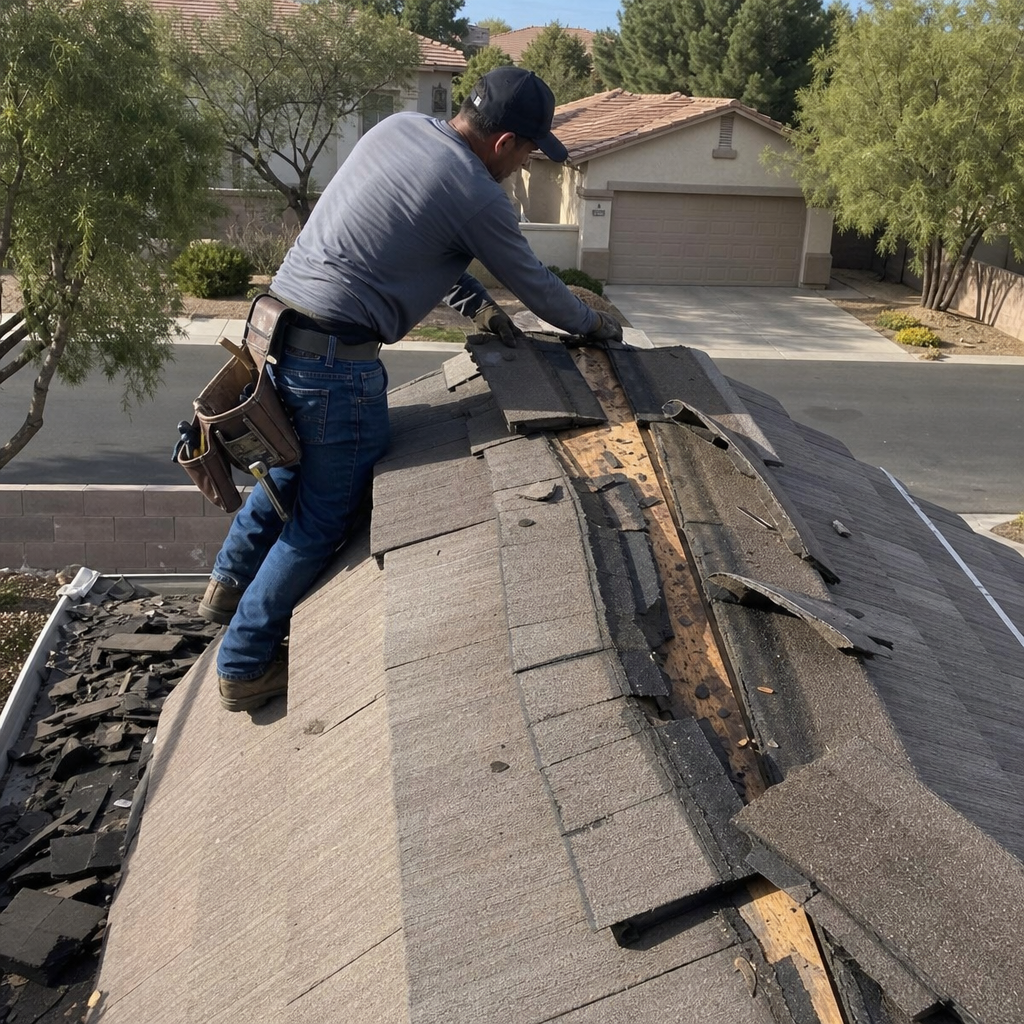
Emergency & Storm Damage in Spring Valley, NV
If your Spring Valley home is leaking after last night’s monsoon — or a wind gust tore through your concrete-tile ridge caps — you need someone who knows this ZIP code, not a dispatcher routing calls from across town. Our Emergency & Storm Damage team serves the 89103 area and surrounding Spring Valley neighborhoods directly, with Santos Cruz on the job personally, not a subcontracted crew. Call us now at (725) 237-7255 for immediate response and a free damage assessment.
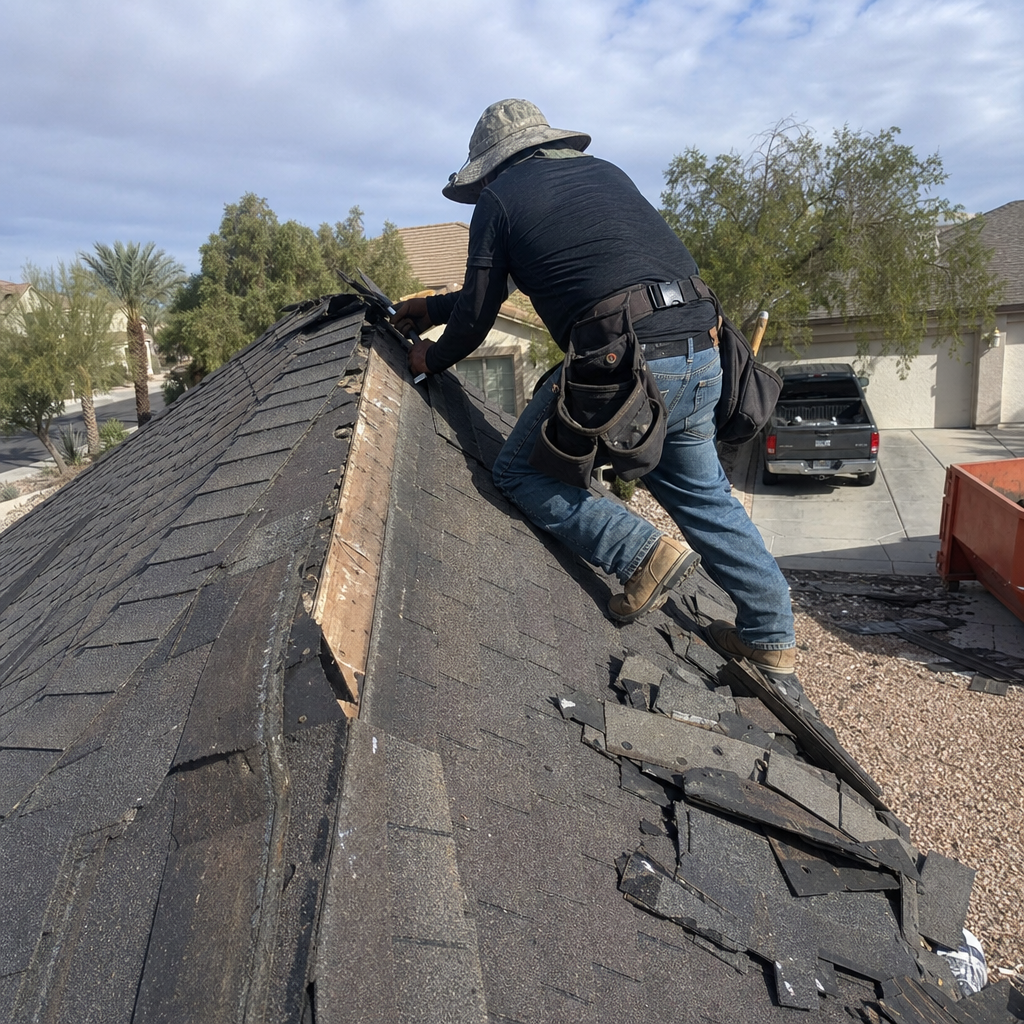
Why All Star Roofing Company Las Vegas Is Spring Valley’s Preferred Emergency & Storm Damage Company
We’ve been working roofs in the Las Vegas Valley for 22 years, and a meaningful portion of that work has been in Spring Valley — the 1980s and 1990s concrete-tile tracts off Flamingo, Rainbow, and Tropicana that we know almost block by block. That familiarity matters when you’re dealing with a post-monsoon leak and need someone who can read the difference between storm damage and a failed 30-year underlayment before pulling a single tile.
Nearly 120 homeowners have left us a 4.9-star rating across 118 verified reviews — and a number of those are Spring Valley customers who called us after a monsoon event and needed answers fast. Santos Cruz isn’t a project manager who hands your job to a crew you’ve never met. He’s the lead technician. He drives to the site, climbs the roof, and makes the call himself.
When a monsoon cell rolls through 89103, we respond to Spring Valley on the same schedule as our Las Vegas proper calls. Emergency tarping, damage documentation for insurance, and Clark County permit coordination — we handle all of it, and we’ve done it enough times in Spring Valley to know exactly how the county process moves after a storm event.
Our Emergency & Storm Damage Services in Spring Valley
Emergency Tarp Installation
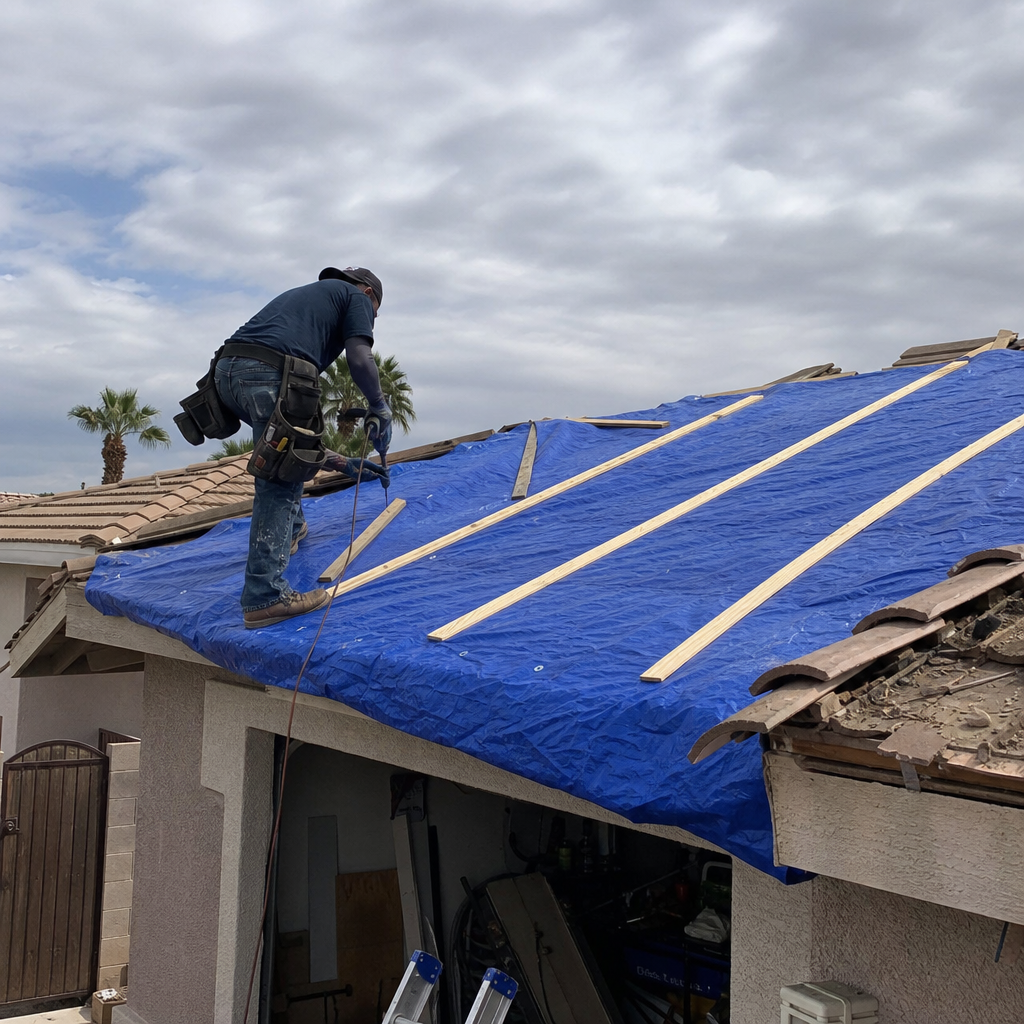
After a fast-moving monsoon, hours matter. Water sitting on a degraded felt underlayment doesn’t stay at the breach point — it migrates laterally under concrete tiles and into ceiling cavities before you see a single stain on drywall. In Spring Valley, where the dominant housing stock is two-story stucco tract construction with original 30-year felt underlayment now well past its design life, we prioritize tarping the field-tile sections first to stop active infiltration. A proper emergency tarp on a Spring Valley tract home typically runs $350–$650 depending on roof pitch and accessible area, and it’s the document your adjuster needs to start the clock on your claim.
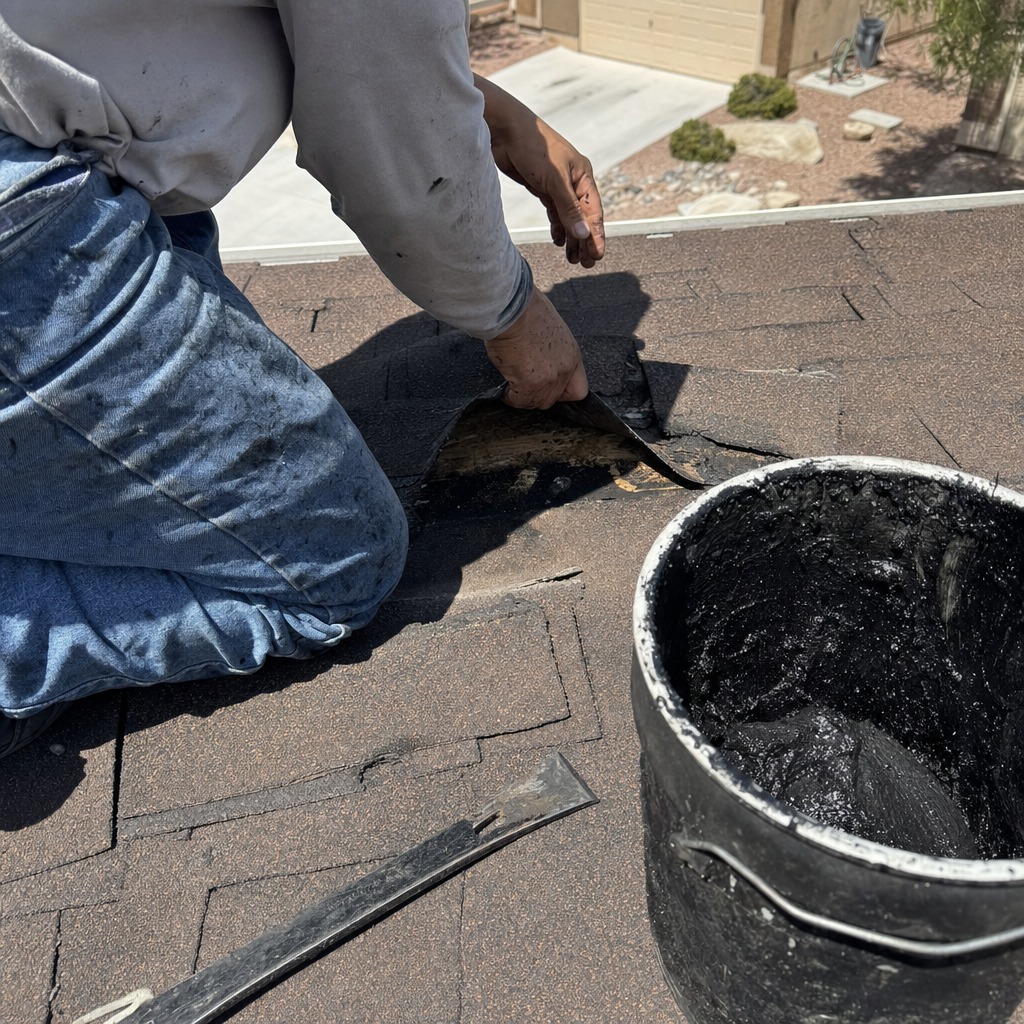
Storm Damage Repair
Spring Valley’s concrete-tile roofs take monsoon punishment in a specific way: the tiles themselves rarely crack from wind alone, but mortar ridge caps — already stressed by decades of thermal expansion and contraction — dislodge and either become projectiles or open water-entry gaps at the ridge line. Storm damage repair in Spring Valley is frequently a combination of re-mortaring ridge caps, replacing isolated cracked tiles, and — once we’re up there — discovering that the real damage driver is underlayment that needed replacement years ago. A targeted storm repair on a Spring Valley tile roof typically runs $500–$2,800, varying by how much tile has to come up to access the underlayment beneath.
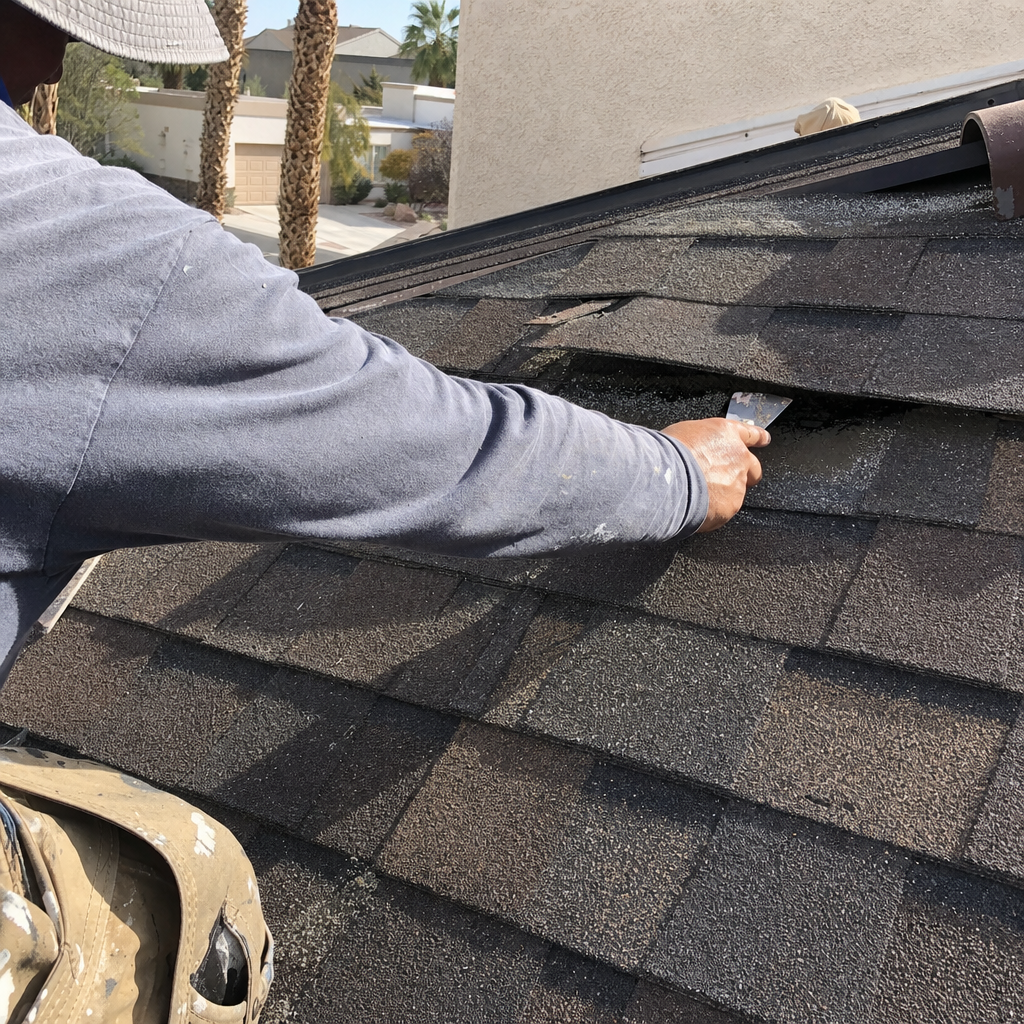
Insurance Claims Assistance
Filing a storm-damage claim on a Spring Valley property carries a wrinkle most adjusters don’t flag immediately: because Spring Valley is an unincorporated Clark County community, permitted repairs go through the Clark County Building Department, not the City of Las Vegas. That means different fee schedules, a separate inspector pool, and a permit timeline that your insurance documentation needs to reflect accurately. We photograph every layer of damage before tarping, produce written scope documentation in the format most major carriers accept, and coordinate the Clark County permit so your adjuster has the paperwork trail they need to process a legitimate claim — not a lowball settlement on an “unmaintained” roof.
Wind Damage
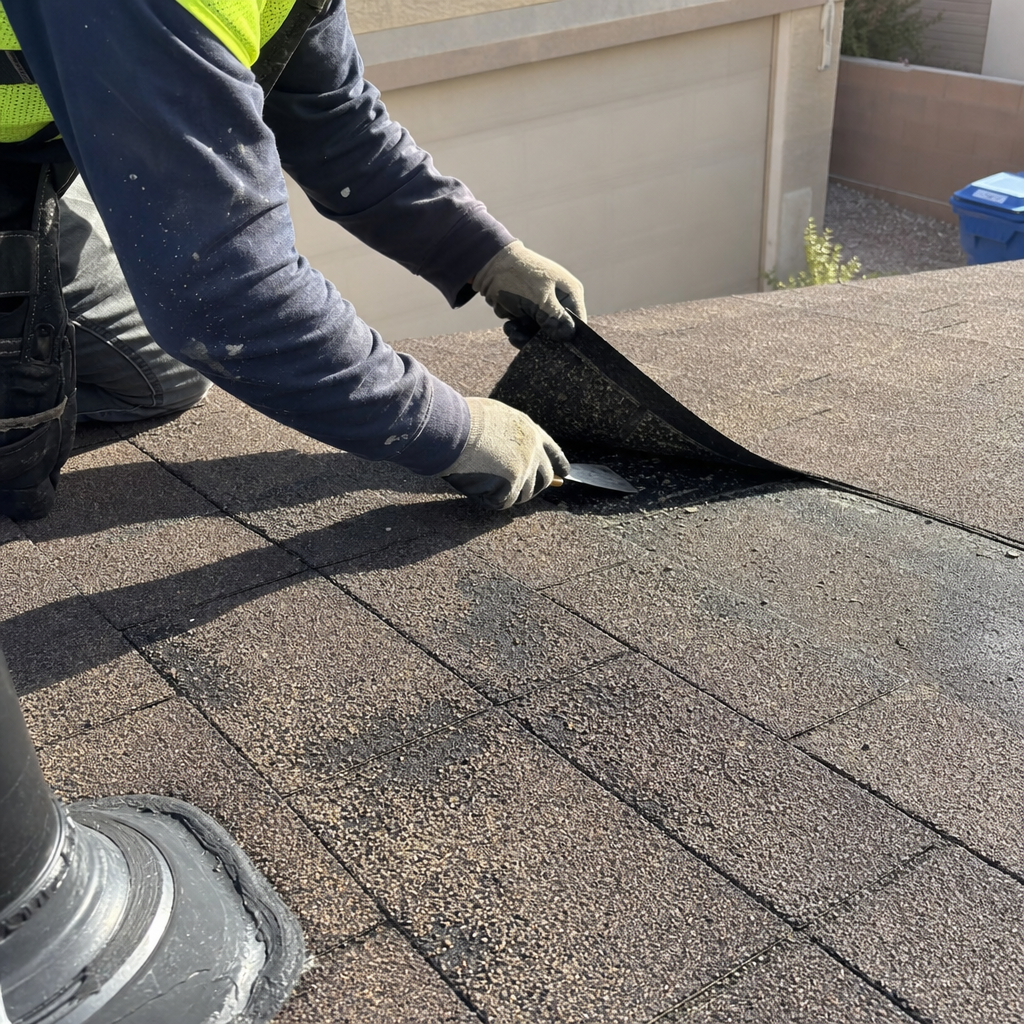
Monsoon wind gusts through the Las Vegas Valley routinely hit 40–60 mph during active storm cells, and Spring Valley sits in a corridor that funnels wind off the Spring Mountains across open subdivisions with minimal windbreak. Mortar ridge caps on 1980s-era concrete-tile roofs are the first casualty — they dry-crack from thermal cycling and then fail entirely under wind load. We document displaced ridge sections, re-mortar with a mix rated for desert thermal cycling, and replace any tiles that shifted or cracked during the event. Wind damage repair in Spring Valley typically starts around $400 for isolated ridge work and can reach $3,500+ if tiles across a full elevation need to be reset.

What happens when you call
- 1
A real person answersNo phone trees — you reach a local pro.
- 2
You get an upfront price rangeHonest numbers before anyone is dispatched.
- 3
A background-checked tech heads outLicensed & insured, dispatched right away.
- 4
You approve before work beginsNothing starts until you say go.
Trusted Brands We Service in Spring Valley
Spring Valley’s concrete-tile roofs were built with material from manufacturers that are still producing compatible product today — Boral and other concrete-tile lines we can source for replacement tiles that match existing field tile closely enough for a clean repair. For homes where underlayment replacement is the primary scope, we work across GAF, CertainTeed, Owens Corning, IKO, Atlas, and Tamko underlayment and roofing systems, selecting based on what’s right for the existing roof structure rather than what we happen to have sitting in a warehouse. That flexibility matters in Spring Valley, where tile matching and system compatibility are the difference between a repair that holds and one that creates new problems.
Common Emergency & Storm Damage Problems We See in Spring Valley Homes
- Interior ceiling stains with zero visible exterior tile damage. This is Spring Valley’s most frequent post-monsoon scenario. The original 30-year felt underlayment — installed during the Clark County suburban build-out of the late 1980s and early 1990s — has been thermally cycled to near-paper consistency and develops pinhole failures that a single heavy monsoon turns into active interior leaks. Every concrete tile above can be perfectly seated and uncracked, and the roof still fails. We saw this firsthand after a fast-moving monsoon cell dropped nearly an inch of rain in under 30 minutes on the 89103 ZIP: the owner of a two-story stucco tract home reported ceiling staining in a second-floor bedroom with no cracked or displaced tiles visible from the street. Our tech found the original felt underlayment had dry-rotted through years of triple-digit thermal cycling, and the sudden monsoon surge turned its pinhole degradation into a live interior leak overnight. We installed an emergency tarp over the field-tile section, pulled a Clark County Building Department permit for a full underlayment replacement beneath the still-serviceable Boral concrete tiles, and had the home sealed and re-inspected before the next monsoon system moved through.
- Mortar ridge cap failure and projectile risk. The mortar holding ridge caps on Spring Valley’s tile roofs cracks from 70–90 days of annual triple-digit thermal cycling, long before the tiles themselves show wear. A monsoon wind gust can send a dislodged cap off a second-story roofline onto a patio or driveway — which is a safety issue before it’s a water issue. Both the emergency tarp and the permanent re-mortaring scope require a Clark County permit on Spring Valley properties, which affects your insurance timeline if you’re counting on that permit as claim documentation.
- Failed elastomeric coating on flat patio-cover foam roofing. A large share of Spring Valley’s 1980s–1990s homes have spray polyurethane foam on the flat patio-cover sections adjacent to the main tile roof. At Las Vegas Valley UV intensity, the elastomeric top coat degrades and loses its waterproofing on roughly a 5–7 year recoat cycle — far faster than manufacturers’ specs written for milder climates. When the coating fails and a monsoon storm hits, the patio deck becomes a standing-water infiltration point that homeowners routinely misread as a problem with the main tile roof. These are two separate roofing systems, each with their own failure mode and repair scope.
- Stucco-to-roofline flashing failures on two-story tract construction. Spring Valley’s two-story stucco homes have a high proportion of wall-to-roof transitions — second-floor dormers, exterior stairwell enclosures, and parapet sections — where metal step flashing embedded in stucco can separate after years of thermal movement. Monsoon rain drives horizontally into these gaps at a rate that overwhelms any sealant remaining. We see this routinely on Rainbow Boulevard and Flamingo Road corridor homes, where original flashing is now 30-plus years old.
Pricing for Emergency & Storm Damage in Spring Valley, NV
Here are realistic ranges for what Spring Valley homeowners are paying in the current market:
- Emergency tarp (concrete-tile tract home, 89103): $350–$650
- Mortar ridge cap re-set and re-mortaring: $400–$1,200
- Targeted storm damage repair (tiles + underlayment section): $500–$2,800
- Full underlayment replacement beneath existing concrete tile (tile-up/tile-down): $7,500–$18,000 depending on square footage and tile re-use rate
- Foam patio-cover recoat (elastomeric top coat restoration): $800–$2,400 depending on deck area
- Clark County permit fee (included in our quoted scope): typically $150–$450 depending on job valuation
What moves your number up is tile-up labor (removing and re-setting mortar-bedded concrete tile is slow, careful work), the condition of the decking once underlayment comes off, and whether flashing needs replacement at wall transitions. We don’t quote flat rates sight-unseen on tile roofs. Call (725) 237-7255 — estimates are free and Santos will tell you exactly what’s driving the cost before any work starts.
We Also Serve Cities Near Spring Valley
Our emergency storm damage response covers the full Las Vegas Valley. Beyond Spring Valley, we regularly work in Las Vegas, Summerlin South, North Las Vegas, and Sunrise Manor — often the same day, sometimes the same crew rotating between adjacent neighborhoods after a widespread monsoon event. If you’re in any of these communities and need emergency roofing response, the same crew and the same phone number apply.
Serving Spring Valley, NV — Our Local Coverage Area
We’re based in the Spring Valley area and know this community well. Use the map below to see our service coverage — if you’re nearby, we can almost certainly help.
FAQs — Emergency & Storm Damage in Spring Valley
Yes, and this is Spring Valley’s most common post-storm roofing scenario. When original 30-year felt underlayment — common on the 1980s–1990s concrete-tile tract homes that make up most of the 89103 residential core — has been degraded by decades of triple-digit thermal cycling, a single heavy monsoon event can turn existing pinhole deterioration into an active interior leak with zero cracked or displaced tiles visible from the street. This is a failure mode that requires a full tile-up inspection to diagnose, not a visual check from a ladder. Call us at (725) 237-7255 for a free inspection — what you’re seeing on the ceiling is real, and the underlayment beneath your intact tiles may need immediate attention.
Spring Valley is an unincorporated Clark County community, so yes — any structural or underlayment repair beyond an emergency tarp requires a Clark County Building Department permit, not a City of Las Vegas permit. The fee schedules, inspector pool, and code-adoption timeline are different from what you’d experience on a Las Vegas proper address. Emergency tarping typically doesn’t require a permit and can happen same day. A permitted full underlayment replacement, however, needs the county’s inspection sequence to close out, which — particularly in the post-monsoon peak season of July through September — can add days to the timeline depending on inspector availability. We coordinate the permit directly as part of our scope, and we document the sequence for your insurance carrier so there are no gaps in your claims paperwork.
Potentially, yes — and the distinction matters. The concrete-tile main roof and the spray foam flat patio-cover section are two different roofing systems with different failure modes, different repair scopes, and potentially different depreciation schedules on your policy. A storm event can trigger legitimate damage on both simultaneously, but a deteriorated elastomeric coating on a foam patio roof may be categorized differently than wind-driven tile damage on the main pitched section. We document both systems separately in our inspection report so your adjuster can evaluate each on its own merits rather than lumping them together and applying one depreciation calculation. Call (725) 237-7255 to schedule a dual-system inspection before your adjuster visits.
Immediately — this is not a “monitor it” situation. Mortar ridge caps on Spring Valley’s older tile roofs are already compromised by years of thermal cracking; a monsoon wind gust doesn’t dislodge them from a position of strength, it finishes what the desert heat started. A dislodged cap on a second-story roofline is a physical hazard below and an open water-entry channel above. The next rain event — which during monsoon season can be 24–72 hours away — will drive water directly into the exposed ridge nailer and down into the wall cavity. If you saw ridge pieces on the ground or heard something shift on the roof during a storm, treat it as an emergency and call (725) 237-7255 for same-response tarping and documentation.
This is the central claims question for Spring Valley’s older concrete-tile housing stock, and the honest answer is: it depends on how the damage is documented. Carriers routinely deny underlayment-failure claims as “gradual deterioration” or “lack of maintenance” when the inspection report doesn’t establish a storm trigger. When a specific monsoon event — a date, a documented rain total, a wind speed reading — is tied to the point at which a degraded underlayment became an active leak, the claim has a legitimate storm-damage basis. The argument isn’t that the underlayment was new; it’s that the storm breached a threshold. We write our inspection documentation with that framing in mind, because we’ve worked through enough Spring Valley insurance claims to know what adjusters look for. Call us before you file so we can build the right paper trail from the start.
Reviewed by Santos Cruz, Owner & Lead Technician at All Star Roofing Company Las Vegas, serving Spring Valley and the greater Las Vegas Valley since 2003.