Last updated June 18, 2026
Roof Repair Maintenance Checklist for Las Vegas Homeowners
The most common call we get after a monsoon isn’t about wind damage — it’s about a small flashing gap that had been sitting there for two years, invisible until three inches of rain hit it in 45 minutes. In a city where it’s sunny 294 days a year, it’s easy to forget the roof is quietly degrading between those storms. Las Vegas homeowners face a maintenance challenge that’s almost the opposite of what they expect: it’s not the rain that destroys most roofs here — it’s the 115°F summers that bake sealants, accelerate granule loss, and cook attic air until shingles age in dog years. This checklist is built around the specific failure patterns Santos Cruz has seen repeat themselves over 22 years of working Las Vegas roofs — not a generic list you could find for any city in America.
Quick Answer
A proper roof maintenance checklist for Las Vegas homeowners includes two annual inspections — one before monsoon season in June and one after summer in October — focused on flashing integrity, sealant cracking, granule loss, ponding water on flat roofs, and attic ventilation. Las Vegas’s extreme UV exposure and rapid-onset monsoon storms create a specific sequence of failure points that most generic checklists miss entirely. Catching those failure points early is the difference between a $250 repair and a $12,000 replacement.
Table of Contents
- Why Las Vegas Roofs Age Differently Than the Rest of the Country
- Pre-Monsoon Checklist (June): The Penetration Points That Always Fail First
- Post-Summer Checklist (October): Reading the Damage UV Left Behind
- Flat and Low-Slope Roofs: Ponding Inspections After Every Significant Rain
- How to Check Attic Ventilation Without Going on the Roof
- Three Tasks Homeowners Can Do Themselves — and Three They Shouldn’t
- Common Mistakes to Avoid
- When to Call a Professional
- Frequently Asked Questions
- The Bottom Line
Why Las Vegas Roofs Age Differently Than the Rest of the Country
Most roofing guides are written for climates with consistent moisture, freeze-thaw cycles, and moderate summers. Las Vegas doesn’t follow that pattern. What we see here is a two-phase aging process: slow thermal destruction during the summer, followed by sudden hydraulic stress during monsoon season. Those two phases working together are why a roof that looks perfectly fine from the street in May can be leaking by August.
The thermal side of it is measurable. Rooftop surface temperatures in the Las Vegas valley regularly exceed 170°F during July and August. At those temperatures, asphalt-based sealants around penetrations — pipe boots, vent flashings, skylight frames — don’t just soften. They pull away from the surfaces they’re bonded to as the deck beneath them expands. Manufacturer data from GAF, Owens Corning, and CertainTeed all acknowledge that UV and thermal cycling are the primary accelerants of sealant failure, and the Las Vegas climate compresses what should be a 10-year degradation curve into 4 or 5 years.
The monsoon side is equally specific. The North American Monsoon system pushes moisture into Nevada between July and mid-September, producing storms that dump rainfall at rates the drainage systems on most Las Vegas homes aren’t designed to handle quickly. We’re not talking about extended soaking rain — we’re talking about 2–3 inches in under an hour. Any gap in a roof system, no matter how small, becomes a funnel under those conditions.
Understanding both phases is what makes a Las Vegas maintenance checklist different. You’re not just looking for wear — you’re looking for the specific points where thermal expansion will crack sealant and monsoon pressure will exploit it.
Pre-Monsoon Checklist (June): The Penetration Points That Always Fail First
Do this inspection in late May or early June, before the first monsoon system arrives. You’re auditing every point where something passes through or terminates at the roof surface — because those are the points where water finds its way in.
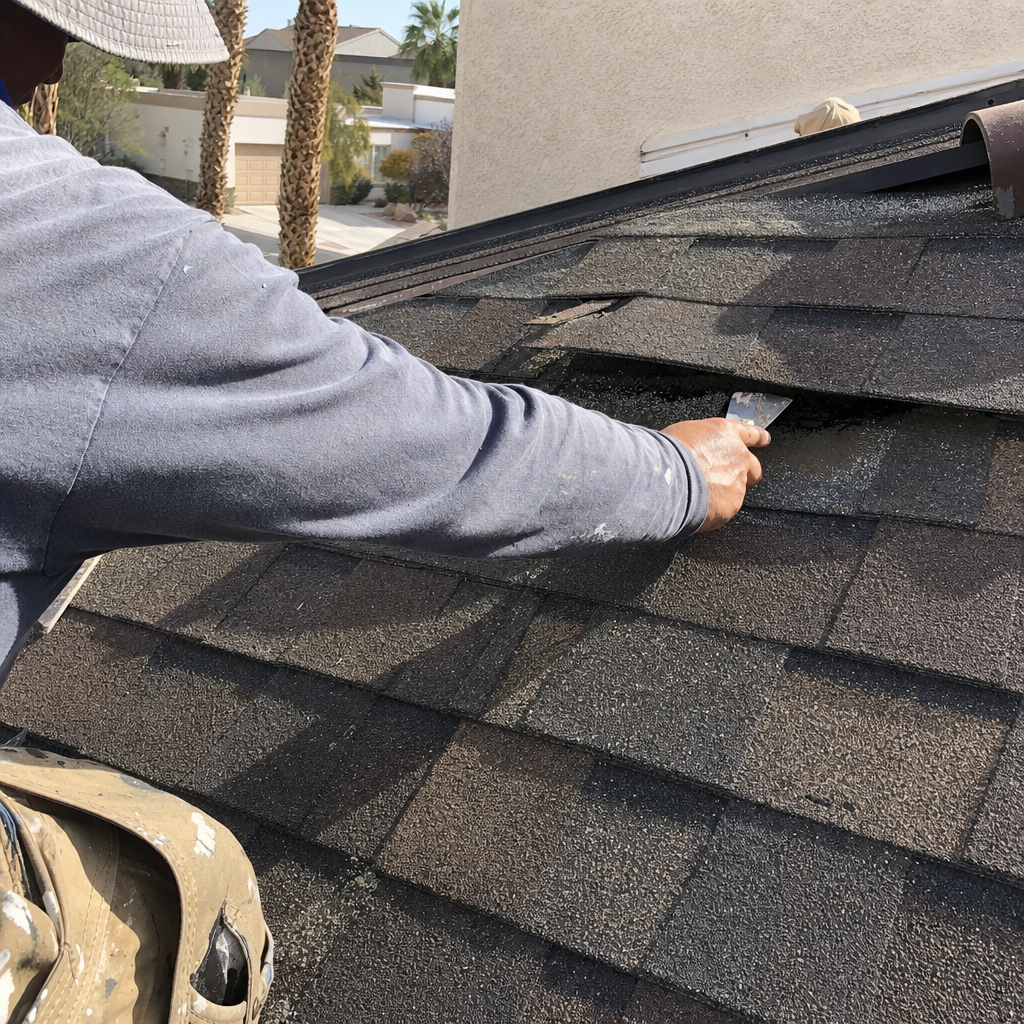
- Pipe boots and plumbing penetrations. The rubber collar around every plumbing vent pipe on your roof degrades faster in Las Vegas than almost anywhere else. Look for cracking, separation from the pipe, or hardening of the rubber. A split pipe boot can let in a surprisingly large volume of water during a hard rain. Replacement is inexpensive and fast — deferring it is not.
- Flashing at walls, chimneys, and step flashing along dormers. Run your eyes along every line where the roof surface meets a vertical surface. You’re looking for gaps, lifted edges, or dried-out sealant that has pulled back from the metal. In areas like Summerlin and Green Valley, where two-story homes with complex rooflines are common, there are often 8–12 separate flashing terminations that each need to be checked.
- Skylight perimeters. The curb flashing around skylights is one of the most frequently neglected spots on Las Vegas homes. The caulk bead along the leading edge (the upslope side) takes the most UV punishment and is often the first to crack.
- Roof vents, turbines, and HVAC curbs. Check the caulk seal where each vent base meets the shingle surface. On flat roofs, check that HVAC curb flashings haven’t lifted at any corner.
- Gutters and drainage paths. Clear any debris from gutters and verify that downspouts are discharging away from the foundation. A blocked gutter during a monsoon storm turns into a dam that backs water under the fascia.
- Shingle surface — granule condition. Walk the perimeter and look in your gutters. A handful of granules after normal wind is expected. A thick layer of granules, or bald spots visible from the ground, means the shingles have already entered accelerated aging.
This is also the right time to address any repairs that surfaced during your October inspection the previous year. Work performed in June, before the monsoon window, gives sealants and adhesives time to cure properly in moderate temperatures before the storm load arrives.
Post-Summer Checklist (October): Reading the Damage UV Left Behind
By October, Las Vegas has put roughly 1,500 hours of intense UV radiation into your roof since the previous fall. That number matters because it’s UV — not rain or wind — that causes most of the cumulative damage on desert roofs. Your October inspection is about reading what that summer left behind.
- Sealant inspection at all penetrations. Revisit every location from your June checklist. Even sealant that looked solid in June may have cracked or separated after a full desert summer. Silicone-based sealants hold up better in this climate than polyurethane or acrylic — if you’re finding failure at the same spots year after year, the product being used matters.
- Granule loss assessment. After summer, walk the roof surface if it’s safe to access, or have a professional do it. On shingles from any major manufacturer — Atlas, IKO, Tamko, Boral — granule loss is the leading visual indicator of remaining service life. Spotty granule loss in isolated zones often points to poor attic ventilation cooking those sections from underneath, not just UV from above.
- Sealant strip integrity on shingles. The factory-applied sealant strip on the underside of each shingle tab is what keeps shingles from lifting in wind. After extreme heat cycles, that strip can fail in patches, leaving individual shingles vulnerable to even modest wind events. Look for any shingles that have lifted edges or are lying slightly raised from their neighbors.
- Fascia and soffit condition. Summer heat and occasional monsoon moisture work together on wood fascia and soffits. Look for any peeling paint, soft spots, or gaps that could allow pest entry or water intrusion behind the fascia board.
- Check the attic temperature differential. On a warm October afternoon, go into your attic and note how hot it feels. If it’s significantly hotter than the outside air and you’re not getting a good cross-breeze from intake to exhaust vents, you have a ventilation problem that will accelerate shingle aging faster than any external factor.
Flat and Low-Slope Roofs: Ponding Inspections After Every Significant Rain
A significant portion of Las Vegas homes — particularly in older neighborhoods like Boulder Highway corridor and parts of North Las Vegas — have flat or low-slope roofs. These roofs require a specific type of post-rain inspection that sloped-roof checklists don’t address.
The threshold that matters for ponding water is 48 hours. Any standing water that remains on a flat roof surface 48 hours after rain has stopped is classified as ponding by most roofing industry standards, and it creates two compounding problems: added structural load, and accelerated membrane degradation at the contact point.
For context on load: one inch of standing water over a 10×10 foot area weighs approximately 520 pounds. On a flat residential roof with standard framing, sustained ponding across a significant area isn’t just a waterproofing problem — it can become a structural one.
What to inspect after rain on a flat or low-slope roof:
- Walk the roof perimeter at ground level and look for any visible deflection — areas where the roofline dips slightly between structural supports.
- Check that all interior drains and scuppers (the openings in the parapet walls that allow water to drain off the edge) are clear and fully open. Debris from monsoon winds — leaves, dust, debris from surrounding lots — commonly blocks scuppers in Las Vegas.
- If you can safely access the roof, look for any areas where the membrane has bubbled or blistered. Blistering near drain locations indicates water is getting beneath the membrane, not just sitting on top of it.
- Check the condition of the gravel or ballast layer if your flat roof uses a built-up system. Wind displacement of ballast exposes underlying membrane to direct UV.
If you’re finding consistent ponding in the same location after multiple rain events, that’s a drainage slope problem — not a patch problem. Patching over a structural drainage issue is one of the most common reasons flat roof repairs in Las Vegas fail repeatedly.
How to Check Attic Ventilation Without Going on the Roof
Poor attic ventilation is, in our experience, the single most underestimated accelerant of premature roof failure in the Las Vegas valley. It’s also the easiest maintenance factor to assess without ever getting on the roof.
The physics are straightforward: in a properly ventilated attic, outside air enters through soffit or eave vents at the low edge of the roof and exits through ridge vents, turbines, or box vents at the peak. This creates a continuous airflow that prevents heat from building up in the attic space. Without it, attic temperatures in Las Vegas can reach 160–180°F — temperatures that cook the underside of your shingles and accelerate the failure of the factory sealant strips.
A simple 5-step attic ventilation check you can do from inside:
- Access your attic on a hot afternoon — ideally when outside temps are above 95°F. Note the temperature difference immediately. It will always be hotter inside, but if it feels extreme (significantly hotter than outside air), ventilation is restricted.
- Look for daylight at the eaves. From inside the attic, look toward the soffit line. You should be able to see light filtering through soffit vents. If it’s completely dark along the eave line, those vents may be blocked or have never been cut through.
- Check for moisture staining or condensation. In Las Vegas, condensation in an attic is rare — but moisture staining on rafters or the underside of the roof deck can indicate that heat is trapping in a way that draws in moisture during the one or two humid monsoon weeks per year.
- Confirm insulation isn’t blocking airflow. One of the most common issues in older Las Vegas homes is blown insulation that has migrated to cover the soffit vent channels. This is an easy fix with baffles, but it requires someone to physically clear the path.
- Count your exhaust vents. General industry guidance is 1 square foot of net free ventilation area per 150 square feet of attic floor area. For a 2,000 sq ft home, that’s roughly 13 square feet of net free area split between intake and exhaust. If your attic has fewer than 3–4 exhaust vents on a standard single-story home, it’s likely under-ventilated.
We’ve diagnosed early shingle failure on roofs in Summerlin, Henderson, and the northwest quadrant of Las Vegas that had nothing wrong with the shingles themselves — the problem was entirely attic heat from blocked soffit vents. Fixing ventilation extended the remaining roof life by an estimated 5–7 years without touching a single shingle.
Three Tasks Homeowners Can Do Themselves — and Three They Shouldn’t
Being clear about this distinction matters — not just for safety, but because several roofing material warranties have specific language about who performs maintenance. Work done incorrectly on a warranted roof can void manufacturer coverage.
Safe for Homeowners to Handle
- Gutter cleaning and downspout flushing. This is straightforward with a ladder and garden hose, and it’s one of the highest-value maintenance tasks you can do. Clear gutters during both June and October inspections.
- Attic ventilation assessment (from inside). As outlined above, you don’t need to go on the roof to check the five ventilation indicators. This is purely an interior assessment.
- Visual perimeter scan from the ground. Using binoculars from ground level, you can identify lifted shingles, obvious flashing gaps, missing granules, and separated caulk lines without any roof access. Document with photos. This is useful information to have before any professional inspection.
Require a Professional — Don’t DIY These
- Any sealant work at penetrations. Applying the wrong sealant product, or applying the right product incorrectly (wrong temperature, inadequate surface prep, insufficient overlap), is a very common source of leak callbacks. Manufacturer warranties for products like GAF or CertainTeed systems often specify that penetration sealing must be performed according to installation guidelines — meaning a botched DIY repair can invalidate coverage on an otherwise intact system.
- Flashing repair or replacement. Flashing work at walls, chimneys, and valleys requires proper seating, fastening, and lapping that’s easy to do wrong and very hard to visually verify from outside. We see improperly DIY’d step flashing on a regular basis in the field — it looks fine until the first real rain tests it.
- Any work on flat roof membranes. TPO, modified bitumen, and built-up roofing systems have specific repair protocols. Incorrect patching can actually trap moisture beneath the repair, accelerating the damage it was supposed to fix. This is one area where the cost of a professional repair is almost always less than the cost of undoing an incorrect DIY attempt.
Common Mistakes to Avoid
- Skipping the pre-monsoon inspection because it hasn’t rained in months. This is exactly backward — the dry season is when thermal damage to sealants occurs silently, and the monsoon is when that damage reveals itself through leaks. Waiting until it rains to check is waiting until it’s too late.
- Using exterior silicone caulk from a hardware store on pipe boots. Not all sealants are rated for the UV and thermal cycling specific to Las Vegas roof surfaces. Using a product rated for standard exterior use on a surface that sees 170°F regularly will produce a failure within one to two seasons.
- Treating a flat roof patch as a permanent fix when ponding is the root cause. In North Las Vegas and older Las Vegas neighborhoods, we regularly see flat roofs that have been patched six or seven times in the same location. If the slope doesn’t direct water to a drain, the patch will fail again. The fix is a drainage correction, not another patch.
- Pressure washing a shingled roof. This is more common than it should be in Las Vegas, often done in an attempt to remove desert dust buildup. Pressure washing removes granules at an accelerated rate and can force water under shingle overlaps. If algae or biological growth is the concern, there are low-pressure chemical treatments that don’t damage the shingle surface.
- Ignoring granule accumulation in gutters after a storm. Granule loss after isolated hail or wind events can be mistaken for normal wear. In Las Vegas, hail events do occur — most frequently in spring months — and concentrated granule loss in a defined area after a storm may be a warranty-eligible damage event that should be documented and inspected professionally before the evidence degrades.
- Delaying attic ventilation repairs because the roof “looks fine” from outside. Ventilation damage is almost entirely invisible from the exterior until shingles begin to show premature aging across whole sections of the roof. By the time it’s visible, years of service life have already been lost. Catching a blocked soffit vent costs almost nothing. Replacing a roof prematurely costs considerably more.
When to Call a Professional
Some conditions on a Las Vegas roof warrant a professional assessment rather than a DIY walk-around. Call a roofer if you find any of the following:
- Any active water intrusion — staining on ceilings, damp insulation in the attic, or visible daylight through the roof deck from inside the attic.
- Shingles that are cracked, curling, cupping, or missing entirely across more than a small isolated area.
- Flashing that has visibly separated from a wall, chimney, or parapet — especially after a significant monsoon storm.
- Ponding water on a flat roof that hasn’t drained within 48 hours of the rain stopping.
- Any roof that hasn’t had a professional inspection in more than three years — in Las Vegas’s climate, three years is a long time between professional eyes.
- Signs of post-storm damage — displaced granules in a specific pattern, dented vents, lifted flashing — that may constitute an insurance-eligible loss event.
All Star Roofing Company Las Vegas offers free estimates across the Las Vegas valley. Santos handles every inspection himself — when you call, you’re getting 22 years of pattern recognition, not a sales visit from someone reading off a checklist. Call (725) 237-7255 to schedule.
Frequently Asked Questions
How often should Las Vegas homeowners inspect their roofs?
Las Vegas homeowners should inspect their roofs twice a year — once in late May or early June before monsoon season, and once in October after the summer UV season. The desert climate creates two distinct damage phases each year, and a single annual inspection will miss one of them. If a significant storm occurs between those scheduled checkpoints, a targeted post-storm inspection is also warranted.
How much does roof maintenance typically cost in Las Vegas?
Minor preventive maintenance — pipe boot replacement, sealant work at penetrations, gutter clearing — typically runs between $150 and $500 depending on the number of penetrations and the current condition of existing sealants. A professional two-point inspection (pre-monsoon and post-summer) often costs less than $300 total and can identify issues before they become $2,000–$5,000 repairs. Call (725) 237-7255 for a free estimate specific to your roof’s condition and size.
Do flat roofs in Las Vegas need more maintenance than sloped roofs?
Yes — flat and low-slope roofs in Las Vegas require at minimum one additional inspection after every significant rain event, specifically to assess drainage and ponding. They’re also more susceptible to UV membrane degradation and require different repair protocols than sloped shingle systems. Many older homes in North Las Vegas and the central Las Vegas corridor have flat roofs, and the maintenance requirements for those systems are distinct enough that general shingle-roof checklists don’t apply directly.
Can poor attic ventilation really shorten my roof’s lifespan in Las Vegas?
Yes, and the effect is measurable. Attic temperatures in under-ventilated Las Vegas homes regularly reach 160–180°F during summer, which accelerates sealant strip failure on shingles from the inside out. Shingles rated for a 30-year service life can begin showing failure characteristics in 12–15 years when attic heat is a chronic factor. Improving soffit and ridge ventilation is one of the highest-return maintenance investments available for Las Vegas homeowners.
What’s the difference between a roof repair and a roof replacement in Las Vegas’s climate?
A repair addresses isolated failure points — a cracked pipe boot, a section of failed flashing, a small area of damaged shingles. A replacement is warranted when granule loss, sealant failure, or UV degradation has progressed across most of the roof surface, meaning individual repairs can no longer address the systemic aging. In Las Vegas, the threshold for that decision often comes earlier than homeowners expect — typically 15–20 years for asphalt shingles, versus the 25–30 year ratings those products carry in milder climates. Our Roof Replacement & Installation in North Las Vegas page covers this in more detail.
Are there specialty roofing options better suited to Las Vegas’s heat than standard asphalt shingles?
There are. Tile roofing — both concrete and clay — offers substantially better thermal performance in desert climates and doesn’t experience the same granule-loss aging pattern as asphalt. Cool-roof-rated TPO membranes on flat applications reflect significantly more solar radiation than standard built-up systems. Some homeowners in newer Las Vegas developments are also choosing metal roofing for its longevity in high-UV environments. Our Specialty Roofing in North Las Vegas page covers the material options suited to this climate in depth.
The Bottom Line
A Las Vegas roof ages on its own schedule — driven by UV, thermal cycling, and sudden monsoon loads that no generic maintenance checklist accounts for. The two-inspection-per-year model outlined here (June and October) exists because those two windows directly bracket the two damage phases every Las Vegas roof goes through annually. Penetration points fail silently during summer heat. Monsoon storms reveal them. Catch the former and you avoid the latter. Nearly 120 Las Vegas homeowners have trusted Santos Cruz and All Star Roofing with that work — at 4.9 stars across those reviews, the standard is clear. For anything beyond what you can safely assess yourself, Roof Repair in North Las Vegas and throughout the greater Las Vegas valley starts with a free estimate at (725) 237-7255.
Written by Santos Cruz, Owner & Lead Technician at All Star Roofing Company Las Vegas, serving Las Vegas since 2004.